Tuesday, April 11, 2017

The Mountain Kingdom: Part 3

You can read my first two posts about our trip to Lesotho here and here.

After the visit to the sangoma, the village tour continued. We were led inside a building where some kind of village council meeting was taking place. Adam said the topic that the council was discussing had something to do with finances needed so that a funeral could be held. I wasn't able to take any photos of the meeting but there were about 12-15 women sitting in a circle on the floor of a dark, one room building. A few of the women had babies with them. Even though it was a warm and sunny day, all of the women were wearing lots of clothing including long skirts, long sleeve shirts and in some cases blankets. The Basotho shepherds that we saw also were wearing blankets even in the hot daytime sun. I am not sure why. 

We left the women to their meeting and drove a bit further down the road to visit a shebeen. A shebeen is a place where beer is brewed. In the past shebeen referred to an unlicensed and often illegal establishment selling alcohol but these days a lot of shebeens are legitimate businesses, although the one we visited may not have been. I have wanted to taste homemade sorghum beer for a while and finally I had my chance. 
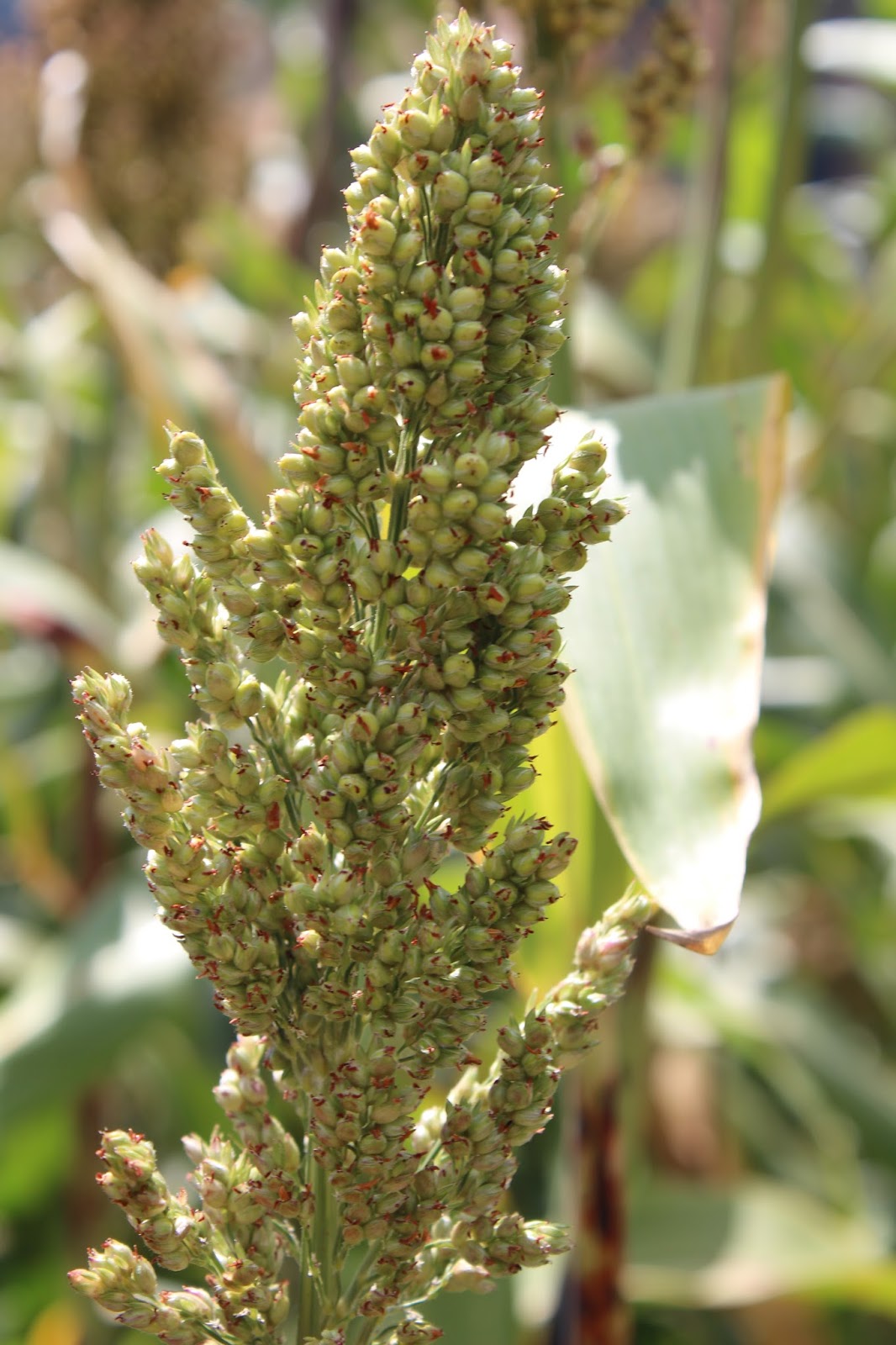

Sorghum close up.

From a distance the sorghum plants look like corn.


My parents and me outside the shebeen/cafe.
Sorghum grain.


Adam tasting the sorghum beer. He told us that he was "scared" of sorghum beer because the amount of alcohol in it varies greatly from batch to batch and one could never be quite sure how strong it would be. I read on another website that the alcohol content can vary between 1% and 8%.
Brewing the beer and stirring it with a huge stick. Photo credit to my mom. 
The sorghum beer is light in colour but cloudy. It did not have a strong alcohol taste but it was very sour. I thought it tasted a little like grapefruit juice. I only had one sip but I didn't hate it and would certainly be open to trying it again if and when the opportunity presents itself. 

The rest of the weekend in Lesotho was spent hiking, horseback riding and enjoying the scenery. If you ever have the chance to visit Lesotho, I recommend staying at the Maliba Lodge. It wasn't perfect as there was an incident when we were served raw meatballs (in fairness they were cooked on the outside) but other than that the food was good, the setting was spectacular and the rooms were clean. And if it's good enough for Prince Harry and King Letsie III, it's good enough for us. 


The hike to black pool. 
My horse was named Pinky. She was a chestnut and she did have a pink hue. She was a great horse very chilled and steady.
Pinky close up. 
Meghan's horse, Bullet (left) and Pinky sharing a drink.
Our horseback riding guides were named Joseph and Justice. 
Joseph crafted himself a hat out of branches to protect himself from the sun. 


Monday, April 10, 2017

The Mountain Kingdom: Part 2


Beautiful Maliba Lodge in Lesotho.
If you missed part one of our trip to Lesotho The Mountain Kingdom, you can find it here.

The morning of our first full day in Lesotho, we made arrangements to tour a local village. Normally, the village tour includes a visit to a school but as it was Saturday school was not in session. The village tour offered by Maliba Lodge is a genuine tour of a village. There is no reenactment, no natives wearing costumes or anything phony. The tour involves going to a village and seeing what is happening there. It's the real deal. 

Our tour guide was named Adam. What was particularly cute and funny was that Adam was also our waiter for breakfast at the lodge that morning. Adam was soft-spoken and based on my informal research quietness and shyness seem to be traits of the Basotho people. Adam's English is very good though, so I can understand why he was selected to be a tour guide. 

Adam is not from the village he took us to, he is from Butha-Buthe another village located about 40 kilometers from Maliba Lodge, but he clearly was very familiar with the village we visited as everyone there seemed to know him. Sadly I can't remember the name of the village we went to. The name is similar to the Sotho word for the round houses that the people live in. The word is not rondevels but another word, which I can't remember.

Adam our tour guide. I'll explain his hat shortly.
Round houses.
For the tour we had to drive ourselves and Adam to the village about 15-20 minutes from the lodge. The village is located on the side of the main, two lane road. It consists of a handful of round houses (again, what are they called?) and some other buildings. Unlike poor communities such as Diepsloot, there are no shacks and no trash. Everything is very clean, with lots of grass, foliage and crops. 


Immediately as we arrived a bunch of curious kids came out of nowhere and began following us around as though one of us was the Pied Piper. The younger kids did not seem to speak English but a few of the older ones, aged ten or so, did. 


We visited the village sangoma, a traditional healer who uses animal bones and herbs to make medicines. I had been hoping to visit a sangoma for a while so I was thrilled for the chance.  In addition to knowing about herbs and healing, sangomas also believe that deceased ancestors play a role in influencing the lives of the living. Sangomas are believed to have certain "powers" such as psychic abilities and the capacity to communicate with dead ancestors. A person can't just decide one day to become a sangoma, sangomas are chosen for their roles when their ancestors visit them during a dream and direct them. Adam told us anyone can learn about herbs and medical uses for them, but a true sangoma must have had the dream and therefore, the calling. 

The sangoma that Adam took us to was an 89 year old woman.  She looked quite healthy and young for her age, except that she did not have any teeth. We visited her in her round hut. While it was small, all four of us plus Adam and the sangoma were able to sit comfortably. It was dark inside the hut, with the only light coming in through the doorway. The hut had a dirt floor and was filled with interesting items including lots of fancy clothing, such as the hat made from porcupine quills that Adam is wearing in the photo above, clothing made of animal skins and clothing with intricate bead work. There were also piles of roots and dried plants, animal bones, a snake skin and other materials gathered by the sangoma to be used for healing. Along one wall were a bunch of jars and cans which I assume were filled with herbs and other found treasures. 


Some kind of animal skin hanging from the thatched ceiling to dry. 

Fortune telling objects. 
The sangoma.
The sangoma did not speak English so Adam explained everything to us and translated for her. After the overview about the dream and the clothing the sangoma asked if anyone wanted his or her fortune read. Only my friend Meghan was brave enough to do so. The cost was R100 (about $7.00)

The fortune reading began with Meghan taking a handful of the fortune telling objects shown in the photo above. The objects included shells, dominos, a coin and some animal bones. Meghan was instructed to blow on the handful before dropping the objects onto a mat so they could be read. When the reading began it was unimpressive especially if you're cynical of such things, like me. First, the sangoma cited the coin saying that Meghan was blessed with wealth. Kind of obvious since we arrived in a car wearing nice clothing. Next, the sangoma said that Meghan suffered from occasional headaches. While Meghan does sometimes have migraines, most people do suffer from headaches now and then so that didn't seem like any great revelation that wouldn't be true for most people. Also, the sangoma said that Meghan suffered from stress. This might sound funny and of course its a generalization, but I think black people in Southern Africa think that white people, as a whole, are very stressed out. So again, I didn't put a lot of credibility into what we were hearing. 

But then things got a little more interesting. The sangoma said that Meghan had been suffering from back pain and described the pain and where in her back it was. For a few weeks leading up to the trip, Meghan's back had been bothering her and at times the pain was quite bad. The sangoma also told Meghan it was important that she announce daily where she was and where she was going as her ancestors were having trouble finding her. So for example, Meghan needs to start saying things out loud, such as "I'm going to Sandton today" and the like. 

To rid herself of the back pain, Meghan was advised by the sangoma to go home, slaughter a goat, and have a party with friends to consume the goat meat together. Meghan was also told to get some tobacco snuff, have all of her friends sit in a circle, put a bit of the snuff on every one's closed fist and then ask everyone to snort it, Finally, the sangoma said Meghan had to drink lots of water every day. Meghan is an animal lover so I don't see her slaughtering a goat. But still it was an interesting experience.

Since our return from Lesotho I have told three African friends that we visited a sangoma. These three friends are all from Zimbabwe and all pretty much had the same reaction even though these were three separate conversations. They all thought it was strange and surprising that we would do such a thing.

Each of them said they did not believe in sangomas or their powers and none of them admitted to ever having visited one. One friend did say that he thought some of the herbs could help you if you were sick or injured and that he didn't have a problem with that part of it but that he did not believe in ancestor worship. Another friend seemed a little more concerned telling me to "watch out for those people" (meaning sangomas) as they can "cause lightning to strike a person." 

Saturday, April 8, 2017

The Mountain Kingdom: Part 1

Beautiful Lesotho
I'll be honest. Before I came to South Africa I had never heard of Lesotho. I don't remember learning any African geography in high school. As I was not the most conscientious student, not remembering doesn't necessarily mean that it wasn't taught to me. I do remember learning European geography (I'm old, Czechoslovakia was still a country back then) which makes me think that African geography was not taught.  In case your geography lessons also fell short, I'll give you a little information about Lesotho and then tell you about our trip there. 

The first thing you need to know is that Lesotho is a country which is physically surrounded by South Africa. The name is pronounced Les Sue Too. In many African languages a Th is pronounced like a T. Just one of the things I've learned in my job as a fake English teacher. The country is also known as the Mountain Kingdom of Lesotho because Lesotho has a king, Letsie III. He recently stayed at the Maliba Lodge, the same place we stayed while in Lesotho. Even more exciting, King Letsie stayed in the same room at Maliba, number six, where my parents stayed. And, as an aside, Prince Harry also stayed in room six recently. Letsie III is a constitutional monarch meaning that his role is largely ceremonial and he doesn't have absolute power. 


Lesotho declared independence from the U.K. in 1966. According to Wikipedia about 40% of its two million plus people live below the international poverty line. Lesotho is mountainous and rural and even though it's physically inside of South Africa, it looks and feels completely different. 

Lesotho has few cities including Maseru (pronounced Mas Ser Roo with a little rolling on the r) the capitol, which is where we flew into from Joburg. That collective gasp that you just heard is the sound of shock and dismay from South Africans reading this post who are baffled to learn that anyone would fly to Lesotho when the distance could be easily driven in just five and a half hours. South Africans love to drive places. They drive from Joburg to Cape Town or from Joburg to Mozambique completely unfazed at spending 12-15 hours in the car each way. But in advance of this trip, Mr. Deep and I decided to fly because our trip to Lesotho was scheduled on the heels of another trip with my visiting parents to Timbavati (next to the Kruger Park) and that was a long drive of six hours each way. 

It's a good thing we decided to fly because about two weeks prior to the trip we found out that Mr. Deep would not be able to go with us to Lesotho as he had to return to the U.S. for a business trip. Yes, this trip was to discuss his next move reinforcing the knowledge that our remaining time here in South Africa is limited. 

I invited my friend and fellow American expat, Meghan, to join my parents and me in Lesotho. It's too bad that Mr. Deep wasn't able to go as he would have liked the scenery and the night sky full of stars an advantage to being in the middle of nowhere without pesky light pollution. But, there are some things about Lesotho that would have driven Mr. Deep crazy.

Specifically, things in Lesotho move very, very slowly. Some people from Europe or the U.S. would say that things in South Africa move slowly but compared to Lesotho, South Africa moves at lightening speed. 

When we arrived at the airport there was just one guy whose job it was to collect all the luggage from the plane, load it onto a cart and bring it inside the terminal. There was a conveyor belt but either it didn't work or it just wasn't used.  Then, we headed out to get our rental car, and the woman behind the counter hand filled out the paperwork. She didn't ask us if we wanted insurance or a GPS or anything like that. She just gave us one of the two cars that she had on site and that was it. There was also no running water in the airport at all. There were regular sinks and toilets but the water just wasn't working and when we returned to the airport four days later to fly back to Joburg, the water still wasn't working.

I think there are only two roads in Lesotho. The roads were paved and seemed to be in much better shape that the holey roads in South Africa. You would think a limited number of roads would make it easy to drive from the airport to lodge without getting lost...but you'd be incorrect. 

We drove for a while and even though we brought our own GPS and the Ops Department/TPT had printed out directions, somehow we missed a turn and ended up at the border crossing moments away from reentering South Africa. We had to explain to the border agents that we didn't want to go back to South Africa, that we had just come from there. One guy asked me to come with him and he took me to a small office where a tourism official gave me some maps in an effort to get us back on the right track. We turned around and then began our three hour drive to the lodge. The trip is only 154 kilometres (96 miles) but all of the roads are just two lanes, with lots of speed bumps referred to as "humped zebras" meaning they are painted with black and white stripes. Because of the speed bumps, or possibly simply because it's Lesotho, people drive extremely slowly. So slowly that I am not sure they are putting any pressure on the gas pedal at all, they may just be coasting. Mr. Deep would have been extremely bothered by the slow drivers as even when we used to drive on the New York State Thruway he would constantly complain about other drivers, being too slow, and "boxing him in like a turtle's pecker."

The drive may have been slow but it was beautiful and interesting. There were people walking along the roads and we saw numerous shepherds dressed in traditional clothing meaning wrapped in blankets, carrying large sticks and wearing cone shaped straw hats, called Basotho hats. Unfortunately my camera and phone were in the (boot) trunk of the car so I don't have any good photos of shepherds with flocks. 

Finally, after a long day of travel we arrived at Maliba Lodge. The lodge is the only five star hotel in Lesotho and it's name is pronounced Ma Deeb A as an L is Sotho is pronounced as a d. When Mr. Deep proofed this post he asked "if an l is a d does that mean the name of the country name is pronounced Des Sue Too?" And the answer is no, it's not and I have no idea why. Regardless, the lodge is in the Tsehlanyane National park and it offers gorgeous views from every angle. 

Kids on the side of the road. Photo credit to my mom.

View of the chalets at Maliba Lodge. 


Thursday, March 23, 2017

A Tale of Two Freezers

While I've only lived in Joburg for two years, some of the things that I used to find surprising I'm now getting used to. I still consider myself to be a fish out of water in this country but the water is becoming more and more familiar. Hosting visitors gives me the opportunity to see things through the eyes of people who are experiencing South Africa for the first time and their comments remind me of the time when I too was new here. 

Recently, I took my friends visiting from the U.S. to Soweto. Because they were on a tight schedule (of course they were) we planned a half day tour. Unfortunately our guide was on Africa time and was an hour late to meet us making the Soweto visit even shorter than planned. We ate lunch at Tintie's, a Soweto must as far as I'm concerned and after Tintie's we went to Kliptown. Kliptown is an informal settlement where people live in shacks with "borrowed" electricity. In Kliptown hundreds of people share one porta potty and residents collect water for washing and drinking in buckets from a central tap. If they need to heat the water they will likely heat it over a paraffin stove or an open fire. This was my third trip to Kliptown and I find it interesting each time I go. While sad, it's also uplifting because the tour includes a visit to a place called the Kliptown Youth Programme, which provides tutoring, sports, meals and more to hundreds of kids who live in Kliptown. 

Part of the tour of Kliptown includes going inside a shack and seeing the conditions in which people in Kliptown live.  It is a strange feeling to venture inside a shack while the residents are there watching you watch them while you look at their home. Each time, I wonder what the residents think. Are they proud of their shacks because they have worked hard to make them livable? Are they hoping if people from the outside see the conditions it will bring about change? Are they just too polite to say no to visitors? I'm not sure. 

Shacks in Kliptown, Soweto
Where people in Kliptown get their water.


Inside a shack with our tour guide from the Kliptown Youth Programme. A young boy is doing his homework in the background.
A tub for bathing and washing 
After we left Soweto, I drove my friends back to our house along a route that I drive almost daily. First, we drove past a Maserati dealership and then a few minutes later we passed a billboard for a company called Doggy Paddle, which offers hydrotherapy for pets. My friend remarked on both sightings saying "we just saw people living in shacks and meanwhile other people are buying Maseratis and sending pets for physical therapy?" And my answer was yes, that's South Africa.


Quick side note, I don't have a problem with pets. I also don't have a problem with people who love their pets and treat them like children or provide them with physical therapy. As you read on, you might think that I do, but I don't. 

The Maserati dealership and the pet hydrotherapy sign sightings reminded me of the freezers, which I have never written about. I live right near a very large Spar, a grocery store. When I tell people where I live they often say, "you live right near the best Spar" and it's true, I do, this Spar is the biggest and the best in Joburg. At the Spar, in the back corner where the meat section is there are two freezers. 

The first freezer, is nondescript. It doesn't have any signage or any markings on it. If I didn't see people crowding around it on a regular basis then I probably could visit the Spar for years without even noticing this freezer. It looks like a freezer that an American who likes to have a lot of frozen food on hand would keep in his basement only it's smaller than that and square shaped instead of rectangular but it does have a lid that opens from the top. 

There is no way to me to explain delicately what this freezer is so I will just tell you. It's the freezer where the poorest of poor shoppers buy their meat. The freezer is filled with clear plastic bags of what look like bones with maybe a tiny bit meat on them. You might be naively thinking that I could easily just open the freezer and take a look or maybe make some nice soup using the bones or at a minimum take a few photos of the freezer contents for the blog, but I can't. White people simply don't open that freezer.  I am too self conscious that if I open it both white people and black people are going to stare at me. I wouldn't be surprised if the minute I opened it a store employee came running over to ask me "ma'am do you need help" which translates into "you must be confused, your meat is over here."

Directly across the aisle from freezer A is freezer B. I have also never opened freezer B but not because I am self conscious, I just don't have a need to open it. Freezer B has clear signage and sells Bentley Natural Dog Food which contains "synthetic vitamins, trace minerals and antioxidants." Their slogan, ironically, is "affordable gourmet dog food so good you can eat it too." The signage on freezer B goes on to state that this dog food is prepared in a kitchen specializing in gourmet human food and that it is balanced by leading pet food nutritionists. 


Freezer A with Freezer B (in green) in the background.
I haven't compared the prices of the contents of the two freezers because to do so, I'd have to open freezer A, which I'm not going to do. Maybe one day I'll work up the courage. 

Shoppers crowding around Freezer A


Wednesday, March 1, 2017

The Execution

On Sunday I saw a woman kill a chicken. She cut its head off. Depending on how you look at it I was either in the right place at the right time or the wrong place at the wrong time. Regardless, it all started with Mr. T. Yes, the guy with the mohawk. 

Last week I found out that our friend Gift is a huge fan of Mr. T.  Gift was born in 1980 in Zimbabwe. He grew up in a poor family and he and his siblings did not have a TV in their home. According to Gift, there were only two homes in the neighborhood that had televisions and those were small black and white sets, not the huge furniture-like TVs that many of us remember from the 80's in America. Somehow, Gift, his siblings and the other kids in the neighborhood became fans of the show the A-Team starring Mr. T. In Zimbabwe, the show aired on Saturday and Gift and the other kids would show up at the home of a TV-owning neighbor in hopes of being allowed to watch the program. The TV-owning neighbor, as you might imagine, was less than thrilled to have tons of kids appearing at his house every week. The neighbor would yell at the kids for tracking dirt into the house but would sometimes relent and let the kids crowd into the doorway of the house and watch the television from there. 

Deny a kid anything and it only becomes more magical and so to this day Gift thinks Mr. T. is "a cool American Black actor." Because Gift hasn't seen many movies and he doesn't own a computer, he was not familiar with Mr. T's full body of dramatic work. He had never seen or heard of Rocky III. I felt that he should see Rocky III, Mr. T's breakout performance, even though Mr. Deep pointed out Mr. T's loses the fight with Rocky at the end which could be a major disappointment. Regardless, Mr. Deep and I invited Gift over for dinner and to watch Rocky III with us. 

Unfortunately, we were not able to successfully download or stream Rocky III (thanks a lot Netflix.) Mr. Deep suggested another movie, DC Cab, but we had the same problem so instead we watched the A-Team movie, which starts Quinton Jackson as B.A., the role made famous by Mr. T. Not a bad substitute. 

But back to the chicken. 

I went to Gift's house at 5:00 to pick him up to bring him to our house for the movie viewing and dinner. When I got there, Isaac, Gift's brother-in-law, had just returned home with a chicken. A live chicken. This situation was like hundreds of others that I've faced since coming to live in South Africa. It is a situation where something is entirely foreign yet entirely relatable all at the same time. 

It is foreign, at least for me, to bring home or have someone bring into my home a live chicken with the intention that we will kill it, prep it, cook it and eat it. What was relatable was that neither Isaac, Gift or Beatrice wanted any part in killing the chicken. I am assuming that each of them have probably killed a chicken at one time or another, but all of them said they were now too scared to do it. They asked me if I wanted to kill the chicken but I declined. Gift's youngest sister, Loice, did not have a problem with it. It seems as though Loice is the designated chicken killer of the family.  As the chicken sat quietly in the doorway of their home, Loice sharpened her knife and created a little hole in the dirt out back so that she could position the chicken properly when she cut it's head off. 

Meanwhile, I knew Mr. Deep was waiting for Gift and me to arrive back at home. He was preparing the mashed potatoes and gearing up for a fun night of A-Team watching. But, for a reason that I can't describe I wanted to watch Loice kill the chicken and so we stayed a bit longer and I watched her do it and I video'd it. I knew Mr. Deep would understand the reason for my delay.

I'm not going to post the video because I know there are a large percentage of you who would freak out. There might even be a few people who have already stopped reading because they can't bear to read about the demise of the chicken. But for those of you who are still with me, let me tell you what it was like. 

First, though the chicken sat relaxed in the doorway for a while, as soon as Loice picked it up, the chicken knew what was up and did not go quietly or without a fight. Second, it did not die right away. There is a reason for the phrase "chicken with it's head cut off." Third, Loice is a total badass. As she killed it, some blood dripped on her feet but she didn't let it bother her. She is a pro.

It's now been over 24 hours since I witnessed the killing. I have not become a vegetarian and I have not stopped eating chicken. In fact, I went to Nando's on Monday and ate some chicken without pause. But watching the chicken get killed did impact me.

First, some might chalk this experience up to hanging around with people who might be characterized as backward or third world. But I would disagree with that. I would argue that killing a chicken you are going to eat is actually more natural then going to the store to buy one. Just because most of us no longer have to kill our own chickens doesn't make it wrong if someone else finds it cheaper, fresher or tastier to do so. Just as we wouldn't think having a garden or going to a farmer's market to get the best and freshest produce is strange we should not be offended by or concerned with a person who chooses to kill his/her own chicken. I calculate that over the course of my life I've eaten chicken a minimum of 5,000 times and the number could be as high as 10,000. So how is it possible given my tremendous amount of chicken consumption that I've never seen a chicken die before? Isn't that a major disconnect? Obviously, I know that chickens and other animals are killed for food and if I see chicken on my plate I know intellectually that it was once alive, but now I really know. 

I have been trying for a while to be more conscious of not letting food go to waste. It seems like it should be easy...just don't buy it or don't order it if you are not going to eat it. However, most of us know it's not easy for those of us who have plenty of food not to waste it on occasion. Now, I really want to re-double my efforts on this and try to consume the food that I purchase so as to not let it go to waste. And if I can't use it, I will give it away. There is no shortage of people here to give it to. Don't worry, I am not going to start making chicken stock from all of my chicken bones or constructing pillows out of chicken feathers. I have not lost my mind.  But if an animal gives its life for us, we, at a minimum, should try not to waste it. And Netflix should do something about their severe lack of Mr. T movie streaming options.


The chicken after the fact.


About Me

My photo
Hello and thank you for taking an interest in my blog. This blog tells the story of some big life changes. First, my husband and I have just moved to Geneva, Switzerland for a few months following a few years of living in Johannesburg, South Africa. The two places could not be more different. I'm excited to share our adventures, challenges and insights with you! My thoughts and opinions are my own.